5 Workplace Perks That Actually Improve Retention in 2026
Employee benefits have never mattered more — and yet most companies are still guessing at what actually makes people stay.
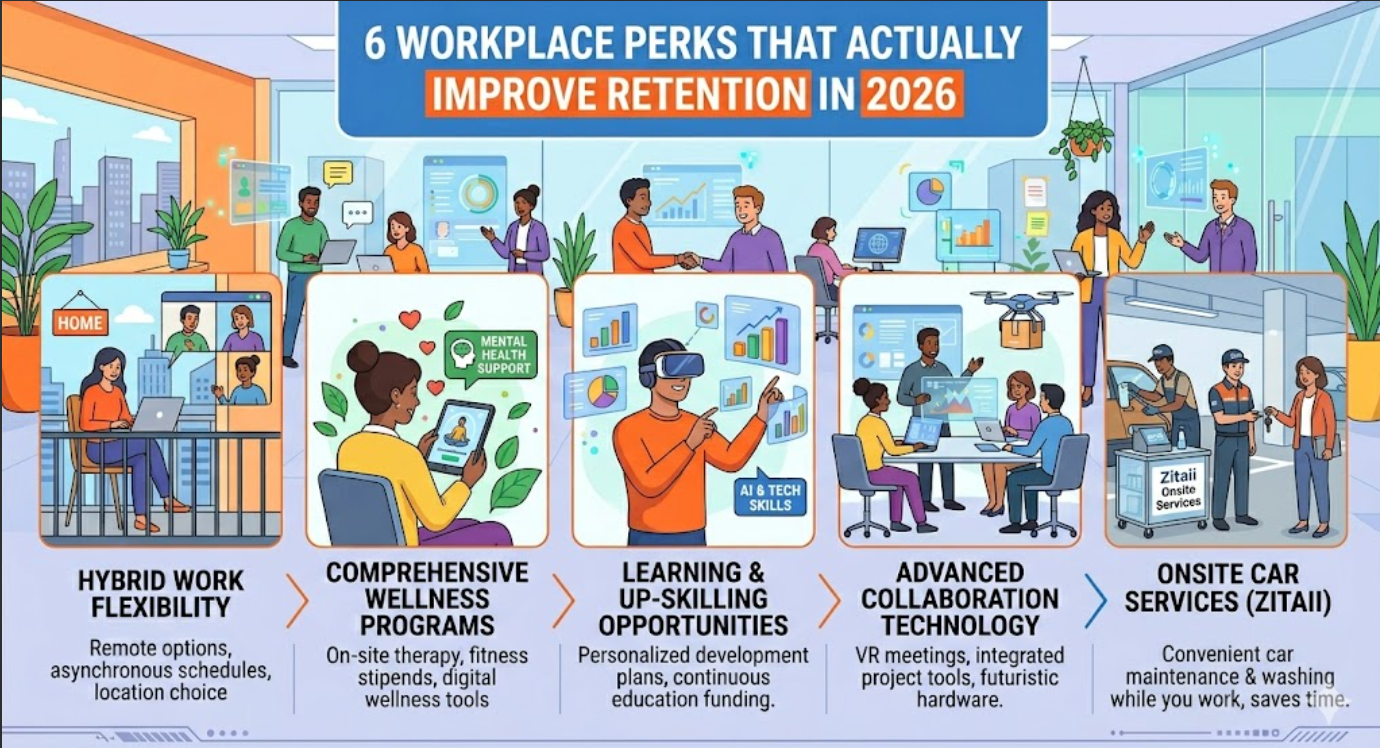
Employee benefits have never mattered more and yet most companies are still guessing at what actually makes people stay.
The standard playbook (ping-pong tables, snack bars, pizza Fridays) is fading fast. In 2026, employees want perks that solve real problems in their lives. According to Paycor's 2026 employee retention research
, 51% of employees are actively seeking new opportunities — and 42% of all turnover is preventable. That's a costly gap, and it's one that smarter benefits packages can close.
Here are five workplace perks that have demonstrated real impact on retention — not just on a survey, but in the daily lives of employees.
1. Flexible and Hybrid Work Arrangements
Flexibility has shifted from a perk to a baseline expectation. SHRM's 2025 Employee Benefits Survey
found that 68% of employers now rate flexible work benefits as "very important" or "extremely important" — and for good reason. Research cited by Emapta
shows fully remote workers achieve a 94.2% retention rate compared to 81.6% for fully in-office workers.
The key is structure. Flexibility doesn't mean absence of expectations. Employers who define in-office time around collaboration, mentorship, and team building — rather than arbitrary attendance requirements — consistently outperform those who enforce rigid schedules. Giving employees control over their time signals that you trust them. That trust pays dividends in loyalty.
2. Meaningful Career Development and Learning Programs
Compensation gets employees in the door. Growth keeps them there.
LinkedIn research cited by Paycor
found that 94% of employees would stay at a company longer if it invested in their career development. Even more striking: companies with strong learning cultures show a 57% retention rate, compared to just 27% for companies with moderate learning cultures. That's more than a twofold difference and it's driven entirely by whether employees feel they're building toward something.
Effective career development doesn't require a massive budget. Structured mentorship programs, internal mobility pathways, and even regular career conversations with managers all move the needle. Employees who see a future inside your organization won't be looking for one outside it.
3. Recognition Programs That Feel Personal
Recognition is one of the most underfunded and underestimated retention tools available to employers.
found that employees receiving high-quality recognition are 65% less likely to be actively job hunting. "High-quality" is the operative phrase it means recognition that is authentic, specific, and tied to real contributions, not a generic monthly award. Employees who feel genuinely seen are 45% less likely to leave within two years.
The practical takeaway for HR leaders: build recognition into the cadence of work, not just annual reviews. Peer-to-peer platforms, manager prompts inside performance tools, and public acknowledgment of team wins all contribute. When recognition becomes part of your culture, retention follows.
4. On-Site Vehicle Care
This one surprises people — and that's exactly why it works.
Most employees drive to work. Most of them also delay routine vehicle maintenance because finding time for an oil change or tire rotation means burning a lunch break, leaving work early, or spending a Saturday morning at a service center. That friction adds up. It's a quiet, constant source of stress that employees don't talk about in exit interviews but feel every week.
On-site vehicle care services like Zitaii eliminate that friction entirely. Zitaii sends certified, insured technicians directly to employer parking lots during the workday. Employees schedule oil changes, tire checks, diagnostics, and detailing — all while they're at their desks. No keys exchanged. No surveillance gaps. No time lost. On average, employees save 3 to 4 hours per service visit.
For employers, the setup is straightforward. Zitaii activates the existing parking lot into a compliant service zone with no construction required. During the DFW pilot, hosting is free to employers — employees pay per service. A real-time dashboard gives employers visibility into time saved, vehicle health trends, and vendor performance. It's a benefit that employees can see and feel every single time it runs.
5. Mental Health and Wellbeing Support
Workplace wellbeing support has moved from "nice to have" to a direct retention driver.
Gallup research cited by Emapta
found that employees whose wellbeing is actively supported are 69% less likely to be job hunting. The EBRI's 2025 Workplace Wellness Survey
found that work-life balance is the top driver of workplace wellbeing, cited by 53% of workers. Benefits that directly reduce stress — including EAPs, mental health days, and on-site support resources — consistently rank among the most valued.
The signal employees are reading is not just the specific benefit itself. It's what the benefit says about their employer. When a company invests in reducing the stress load outside of work, it communicates something powerful: we see you as a whole person, not just a headcount.
The perks that drive retention in 2026 are the ones that solve real problems. Flexibility, growth, recognition, reduced daily friction, and genuine wellbeing support all share a common thread — they demonstrate respect for employees' time and lives outside their job description.
On-site vehicle care may not be the first thing that comes to mind when you think about benefits strategy, but for employees who drive to work, it removes a genuine pain point. And removing pain points, it turns out, is one of the most effective retention strategies available.
Want to bring on-site vehicle care to your workplace? Visit Zitaii at zitaii.com
to learn how the DFW pilot works and how your parking lot can become an employee benefit — at no cost to host.