Future of Work and Mobility
Why Employee Car Maintenance Is an HR Problem
Car maintenance is quietly draining employee time and wellbeing. Learn why HR leaders are starting to treat vehicle care as a workplace benefit.
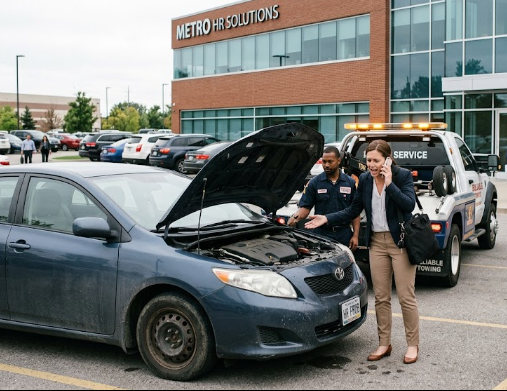
Car maintenance does not feel like an HR issue — until you start counting the hours it costs your workforce.
The average American spends between $936 and $1,200 per year on vehicle maintenance and repairs, according to RepairPal and AAA data.
That figure represents real money. But the hidden cost is not dollars — it is time. A typical car service appointment runs three to five hours from start to finish, including driving to the shop, waiting, and driving back, according to BrokerLink's automotive service research
. Multiply that by the number of employees on your payroll, and you are looking at a significant productivity drain hiding in plain sight.
The Time Burden Your Employees Are Carrying
Most employees do not have the luxury of dropping off their car at 8 a.m. and walking home. They navigate shop hours, coordinate rides, sit in waiting rooms, and rearrange their day around a single service visit. An oil change alone can eat two hours when you factor in travel and wait time.
According to J.D. Power's 2024 Customer Service Index Study
, the average wait time to even get a service appointment at a dealership has climbed to 5.2 days — up from 4.8 days the year before. That delay creates its own downstream effects: employees put off maintenance, vehicles deteriorate, and when something finally does break, the disruption is far larger.
How This Becomes Your Problem as an HR Leader
When employees cannot handle personal logistics during business hours, they find other ways. They leave early. They come in late. They burn PTO on tasks that have nothing to do with rest or recovery. They carry mental load into meetings, reducing focus and output.
Research consistently shows that employees who feel financially and logistically stressed at home are less engaged at work. According to Wellhub's 2025 State of Work-Life Wellness Report
, wellbeing is equally important to salary for 88% of global employees — and only 59% say their current benefits program is excellent or good. The gap between what employees need and what employers offer is real, and it is growing.
Car maintenance falls squarely in that gap. It is a recurring, predictable, time-consuming burden that employees deal with alone — even though it directly affects their availability and mental bandwidth at work.
Why Vehicle Care Is a Benefits Opportunity
HR leaders have long focused on health insurance, retirement plans, and mental health resources. Those remain foundational. But the benefits landscape is shifting. SHRM's 2026 State of the Workplace data
points to a growing demand for non-traditional perks that make employees feel seen — benefits that solve real, everyday problems rather than adding to an already long list of unused programs.
On-site vehicle care is one of those benefits. When employees can get an oil change, tire check, or diagnostic done while they are already at work, they do not lose a half-day. They do not have to coordinate rides or reshuffle their schedule. The maintenance happens in the background, and they stay focused on their work.
The Compliant, Low-Effort Model Already Exists
This is not a hypothetical. Zitaii brings certified, insured technicians directly to employer parking lots across the DFW area. No construction is needed — existing parking spaces are activated as compliant service zones. No keys are exchanged. Surveillance-ready protocols are in place. Employees book and pay through the app; employers host at zero cost during the current pilot.
For every service visit, Zitaii saves employees three to four hours compared to going to a traditional shop. Across a workforce of 200 people, that adds up to hundreds of hours returned to employees — and to your business — each service cycle.
Making the Business Case to Leadership
If you are an HR leader trying to justify a new benefit, the math here is straightforward. Unscheduled absenteeism costs U.S. employers an estimated $1,685 per employee per year
, according to the CDC Foundation. Any benefit that reduces last-minute schedule disruptions — even modestly — pays for itself quickly.
On-site vehicle care is not a luxury perk. It is a practical solution to a problem employees are already dealing with, whether you address it or not. The question is whether you want to be the employer who noticed — or the one who did not.
Ready to see what on-site vehicle care looks like at your location? Visit zitaii.com
to learn how the DFW pilot works and get started at zero cost to your organization.